
Wexford Projected and Actual Release
A projected date is a calculated or conditional point in a sentence. An actual release date records a custody event that has already occurred. Michigan’s public state-prison system does not label one field “projected release date.” OTIS uses Earliest Release Date and Maximum Discharge Date. The earliest date is also called the Parole Board Jurisdiction Date. It marks when the Board may consider release for an ordinary indeterminate sentence. It is not a scheduled exit. The maximum date is the potential end of MDOC authority if parole does not occur sooner, subject to the controlling sentence and MDOC calculation.
A Wexford County Jail detainee requires a different reading. Someone awaiting trial may leave after bond, dismissal, or a court order, yet no fixed date exists before that event. A sentenced jail prisoner can have an end date based on the judgment, custody dates, jail credit, and applicable county good time. A felony defendant committed to MDOC may leave the Wexford jail for prison. That departure is a transfer, not release to the community.
Find a Wexford Projected Release
Start with the last known custodial agency. OTIS excludes people held only in county jails. Wexford County Jail does not publish an online roster or release-date calculator. The court record and jail are therefore the local sources. For a state prisoner, the official MDOC OTIS page leads to the public profile and its exact date fields.
- Determine whether the person is awaiting trial, serving a county jail sentence, or serving an MDOC prison sentence.
- For Wexford jail custody, search MiCOURT for the signed judgment, bond order, jail credit, and any later amended order.
- Call Wexford County Jail at 231-779-9217 for the public calculation or current departure status.
- For an MDOC prisoner, use the MDOC number in the OTIS offender search, then verify the profile identity.
- Read Earliest Release Date, Maximum Discharge Date, current status, sentence rows, and court file number together.
- Check for parole, another active sentence, a detainer, or a transfer before treating any date as an expected community release.
When the Wexford court file is unclear, request the signed judgment and commitment from the proper clerk. The 84th District Court handles misdemeanors and preliminary felony proceedings. The 28th Circuit Court holds felony sentencing records after bindover. For a broader custody search path, use the Wexford County released inmate lookup. A precise request should seek existing booking dates, sentence credit, the jail’s calculated release date if maintained, and the authority for release or transfer.
The official OTIS record uses fixed Michigan terms that should be copied as shown. The result can include MDOC number, current status, assigned location, earliest release, maximum discharge, Date Paroled, sentences, sentencing county, and court file number. A sentence row marked discharged can coexist with another active sentence. Always let the profile status and all active terms control the conclusion.
Wexford Jail Good-Time Calculation
County jail good time and state prison parole dates are separate systems. For an eligible sentenced Wexford County Jail prisoner, MCL 51.282 and 51.283 govern good-time allowances and records. Good time is a statutory reduction tied to observing jail rules. Misconduct can cause forfeiture. The jail applies the schedule to the actual sentence and keeps the relevant infraction record. Court-awarded jail credit also affects the endpoint.
An accurate county calculation needs the signed sentence, commitment, booking and custody dates, jail-credit amount, and the jail’s good-time record. Pretrial bond is not good time. A person who leaves on bond has met a pretrial release condition rather than completed a reduced sentence. Likewise, an order of time served supplies legal authority but should still be paired with the jail or VINE event for the physical timestamp.
No Wexford official source states a fixed release hour, a special trustee credit, or an automatic weekend or holiday adjustment. No rule was found that moves a Sunday endpoint to Friday. Do not estimate one. Ask the jail about the named person’s individual calculation and any other hold.
Note: County jail good time applies to eligible sentenced prisoners, not to a pretrial detainee waiting for bond or a court decision.
Why Wexford Release Dates Change
A date can move because the legal sentence, credit calculation, conduct record, or next custodian changes. Multiple cases deserve special care. Consecutive sentences run one after another, while concurrent sentences run at the same time. A new judgment, appeal, remand, or corrected commitment may alter the term. A local sentence can end while another county, federal agency, MDOC, or immigration authority takes custody.
| Factor | Effect on the date | Best record |
|---|---|---|
| Jail good-time loss | Forfeited credit can extend a county jail term | Jail calculation and infraction record |
| Jail credit correction | Corrected prior-custody credit can move the endpoint | Signed or amended court judgment |
| Consecutive sentence | A second term begins after the first | Judgments and OTIS sentence rows |
| Detainer or warrant | Current term may end while custody continues elsewhere | Release record and receiving agency |
| Parole decision | Grant can permit release after planning; denial keeps the prisoner confined | OTIS and Parole Board record |
| Rescission or new case | A grant or earlier estimate may no longer control | MDOC status and current court file |
The destination matters as much as the date. “Released from Wexford County Jail” can mean transferred to MDOC. “Not in BOP custody” resolves only federal custody. An ICE pickup is also a transfer. Ask for the release type and receiving agency when the record maintains those fields.
Confirm Wexford Actual Release Dates
MI-VINE is the principal online custody-event source when the Wexford sheriff has no public roster. Search the specific person under Michigan, confirm the custodial agency and identifier, and read the event text. Release, transfer, and escape are different events. Registering for an alert can help with a future change, but agency data may lag the physical event. A VINE notice is not a certified sentence calculation.
For a state prisoner, compare the OTIS Date Paroled and Current Status after the event. “Parolee” means the person left prison but remains under MDOC legal custody. “Discharged” means MDOC supervision ended, though MDOC notes that discharge can include maximum discharge, successful completion, or death. A Wexford jail-only case will not appear in OTIS. The Wexford VINELink inmate search explains the specific-person event and alert fields.
Historical proof comes from the record created by the right agency. Request a Wexford jail register or booking-release record for a county event. MCL 801.4 requires the jail calendar to record the date and authority of liberation. Ask the court for the signed order that supplied legal authority. For an MDOC event, request the discharge certificate or other releasable material. The time shown by the custodian and the authority shown by the court should fit together.
Wexford Prison Release Date Rules
Michigan uses indeterminate sentencing for most state prisoners. A judgment sets a minimum and maximum. The earliest release date marks Parole Board jurisdiction, not a sure release. Under MCL 791.234, eligibility and Board authority depend on the sentence and offense. Some life offenses are not eligible for parole, while eligible life cases follow special rules. The person’s OTIS profile and actual judgment are safer than a calculation based on a headline sentence.
Michigan truth in sentencing is often described incorrectly as an 85 percent rule. The MDOC sentencing FAQ says the modern rule for affected offenses eliminated disciplinary credits and good time toward the minimum and requires the entire judicial minimum in prison before parole consideration. The federal shorthand does not govern a Wexford MDOC sentence. Older sentences may have different credit rules, so the offense date and governing law matter.
The Michigan parole consideration process also separates a grant from departure. MDOC states that release planning requires at least 28 days between the Board’s decision and physical release in a granted case. A grant date is thus not an actual gate date. Parole can occur after the earliest date and before maximum discharge, but only when the Board grants it and release processing is complete.
The official Michigan parole statute page shows the legal framework used when Board jurisdiction is assessed.
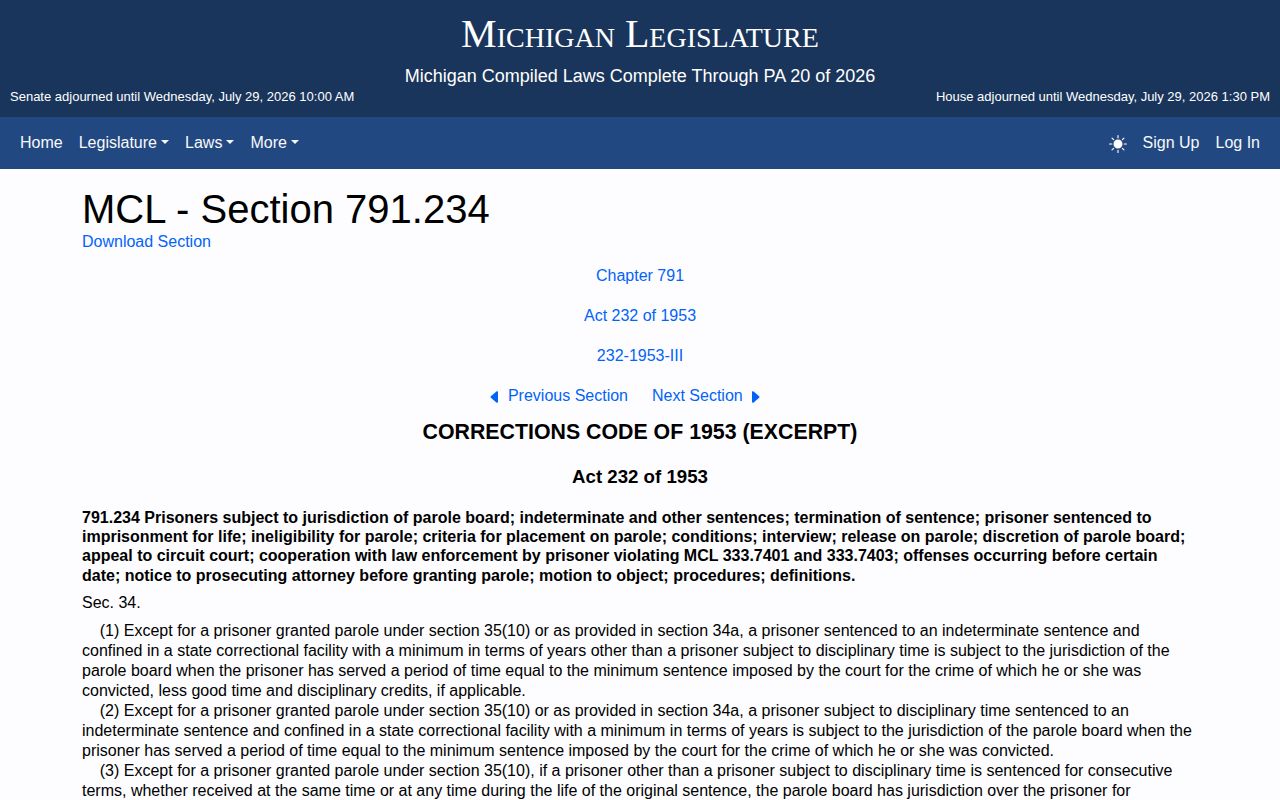
That legal framework explains why the OTIS earliest release date is an eligibility point instead of a promised departure date.
Wexford OTIS Release Date Fields
An OTIS result carries more than two dates. The surrounding identity and sentence fields determine whether the date belongs to the right Wexford case. Search by MDOC number when it is known. A name search should be checked against aliases, age, identifying marks, sentencing county, and court file number. The system can also show status, current location or supervision location, a photograph and its date, the offense, Michigan statute citation, and minimum and maximum sentence terms.
| OTIS field | How it affects release research |
|---|---|
| Current Status | Distinguishes Prisoner, Parolee, Probationer, Discharged, Escapee, or Absconder |
| Earliest Release Date | Shows the parole jurisdiction point, not a guaranteed departure |
| Maximum Discharge Date | Shows the potential MDOC endpoint if parole does not occur sooner |
| Date Paroled | Records when MDOC states the person left prison on parole |
| Sentencing County and file | Connects the profile to the Wexford judgment that created the sentence |
| Active sentence rows | Reveal whether another sentence can keep MDOC jurisdiction in place |
OTIS covers state prisoners, parolees, qualifying probationers, and people within its public post-discharge period. It does not cover a person held only at Wexford County Jail. A no-result can also reflect the system’s three-year post-discharge display limit, an exempt record, or an identity mismatch. For an older case, seek the Wexford judgment and ask MDOC about a discharge certificate or the public parts of a PENPACK.
A PENPACK is MDOC’s release-related packet for a paroled or discharged offender. The department’s FAQ says it may include a certified Judgment of Sentence, Basic Information Sheet, Parole Eligibility Report, photo, fingerprints, and Discharge Certificate. Some components can be restricted. A narrow request for the discharge certificate and basic sheet avoids assuming that every item is open. For an OTIS data error, save the profile URL, MDOC number, access date, and disputed field before contacting MDOC.
Note: Copy the Michigan date labels exactly, since replacing them with “scheduled release” makes a conditional eligibility date sound certain.